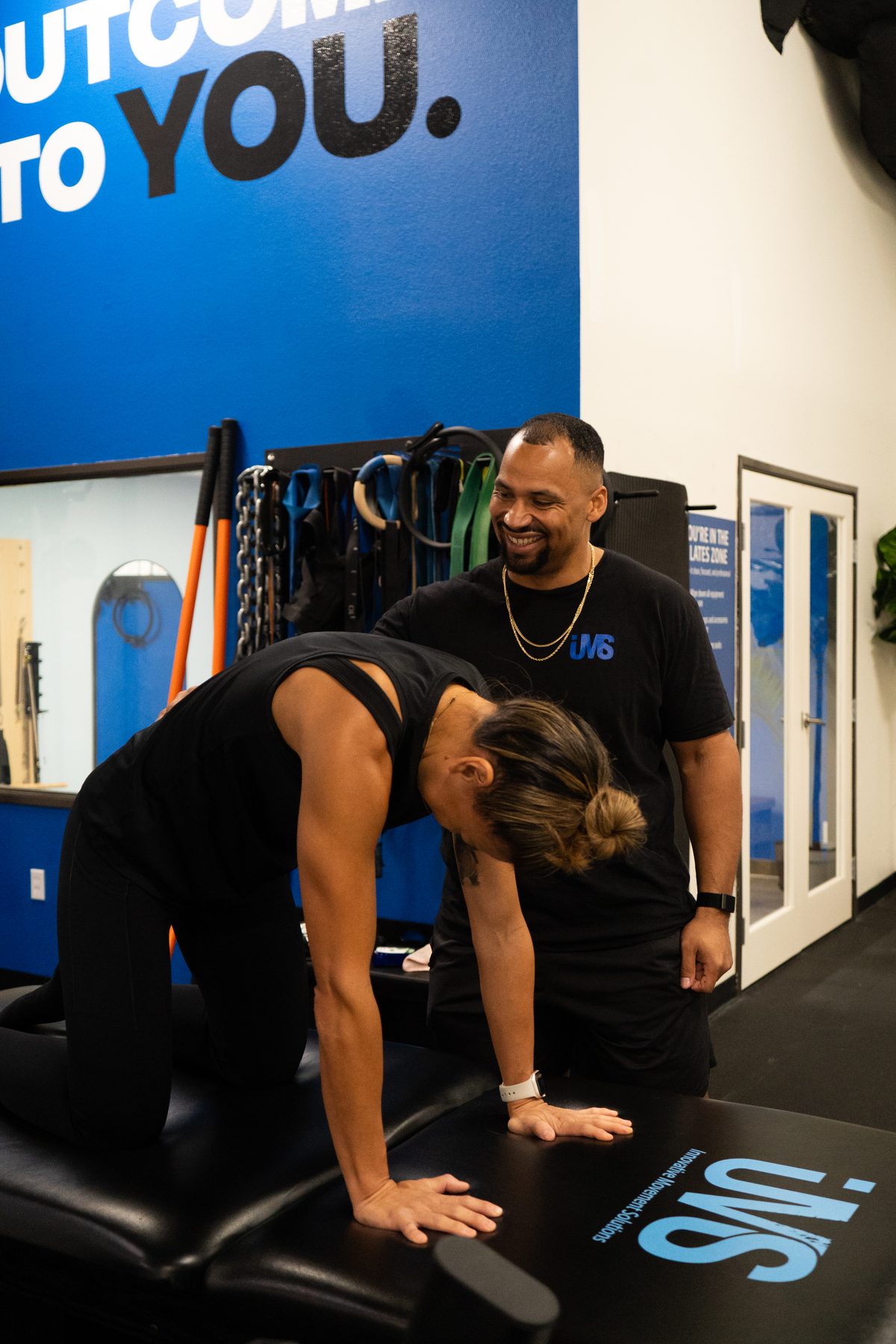
I coach in Scripps Ranch. A large share of my clients work in tech, biotech, or defense, which means they spend six to nine hours a day in a chair and then try to do something athletic on the weekend. The complaint arrives in one of three forms: tight hips, a low back that aches by Thursday, or a squat that has quietly stopped going as deep as it used to.
The internet's answer is "sitting is the new smoking," which is both alarmist and useless. Here's the more accurate version.
Sitting doesn't damage anything. It teaches something.
Sitting is a position. Positions aren't harmful. What matters is how much of your total movement you spend in one narrow band of what your joints can do.
When you sit, your hips are held at roughly ninety degrees of flexion, neutral rotation, and no abduction. That's one small neighbourhood inside a joint capable of a very large territory. Do that for thirty thousand hours over a decade and your body does something entirely reasonable: it stops maintaining the range you never ask for.
This isn't damage. It's economy. Your body is expensive to run and it doesn't fund capacity you don't use.
What actually narrows
Three things, in the order I usually see them:
Hip internal rotation. The first to go and the one almost nobody trains. It's the motion of the thigh bone rotating inward in the socket. You use it every time you rotate over a planted leg — a golf swing, a tennis stroke, changing direction on a hike. Sitting demands none of it.
Hip extension. The ability to take your leg behind you. Sitting keeps the hip permanently flexed, so the end range of the opposite direction stops being visited.
Control at the edges. Even where range survives, the strength to produce and hold that range under load quietly disappears. This is the part stretching does not address.
Why your low back is the one complaining
Here's the mechanism that makes this worth caring about.
Rotation has to come from somewhere. If your hips can't supply it, your lumbar spine will — it's the next joint up the chain and it's willing. But the lumbar spine is built for stability, not rotation. It has maybe fifteen degrees of it, total, across five vertebrae.
So the golfer with restricted hip internal rotation doesn't feel it in the hips. He feels it in the back, on the eleventh hole, every time. The restriction is in one place and the symptom shows up in another, which is exactly why treating the site of the symptom so often fails.
Same story with ankles and knees, hips and shoulders. Joints don't work alone.
Why stretching hasn't fixed it
Most people arriving with this pattern have already tried stretching, usually for years, usually with a hip flexor stretch they found online.
Passive stretching pushes a joint into a position using something other than your own muscles — gravity, a wall, your hands. It can temporarily increase the range you can be placed in. It does very little for the range you can produce.
That gap matters. The territory you can be pushed into but can't control is unguarded: your body can end up there during a real-world moment without the strength to manage being there. Widening that gap without training control is not obviously an improvement.
This is the core claim of Functional Range Conditioning, and it's why we open every session with active work rather than a stretch routine.
What actually helps
Controlled Articular Rotations for the hip. The largest circle the hip can make under its own power, slowly, with everything else held still. Sixty to ninety seconds a side. Unglamorous, and the thing that moves the needle. The five-minute morning routine has the hip version with a diagram.
Train internal rotation specifically. Nearly nobody does. Sit on the floor, knees bent and feet wide, and let one knee drop inward toward the floor without your pelvis lifting. That's the range in question. Most desk workers find it startlingly limited on the first attempt.
Load the range you regain. Range without strength doesn't hold. Once a hip can produce a position, it needs to be loaded there for the adaptation to stick. This is the step home mobility routines skip, and it's why they plateau.
Break the day up. Not because sitting is toxic, but because the fix is variety. Standing for a few minutes every hour, in a genuinely different position, is worth more than a heroic gym session on Saturday.
How long it takes
Longer than you want. Joint capsule and connective tissue adapt slowly — think months, not weeks. Most clients notice their squat feels different somewhere around week six, and notice the back stops complaining somewhere later than that.
The honest framing: you spent ten years teaching your hips they only needed ninety degrees. Re-teaching them takes more than a fortnight of enthusiasm.
If you want to know where you actually stand, the movement self-check includes a hip rotation test you can do on your floor right now.
IMS provides coaching, movement education, and recovery services. IMS does not diagnose, treat, or cure medical conditions. Back pain has many possible causes and this article is not a diagnosis of yours — if you have persistent or severe pain, see a licensed healthcare provider.