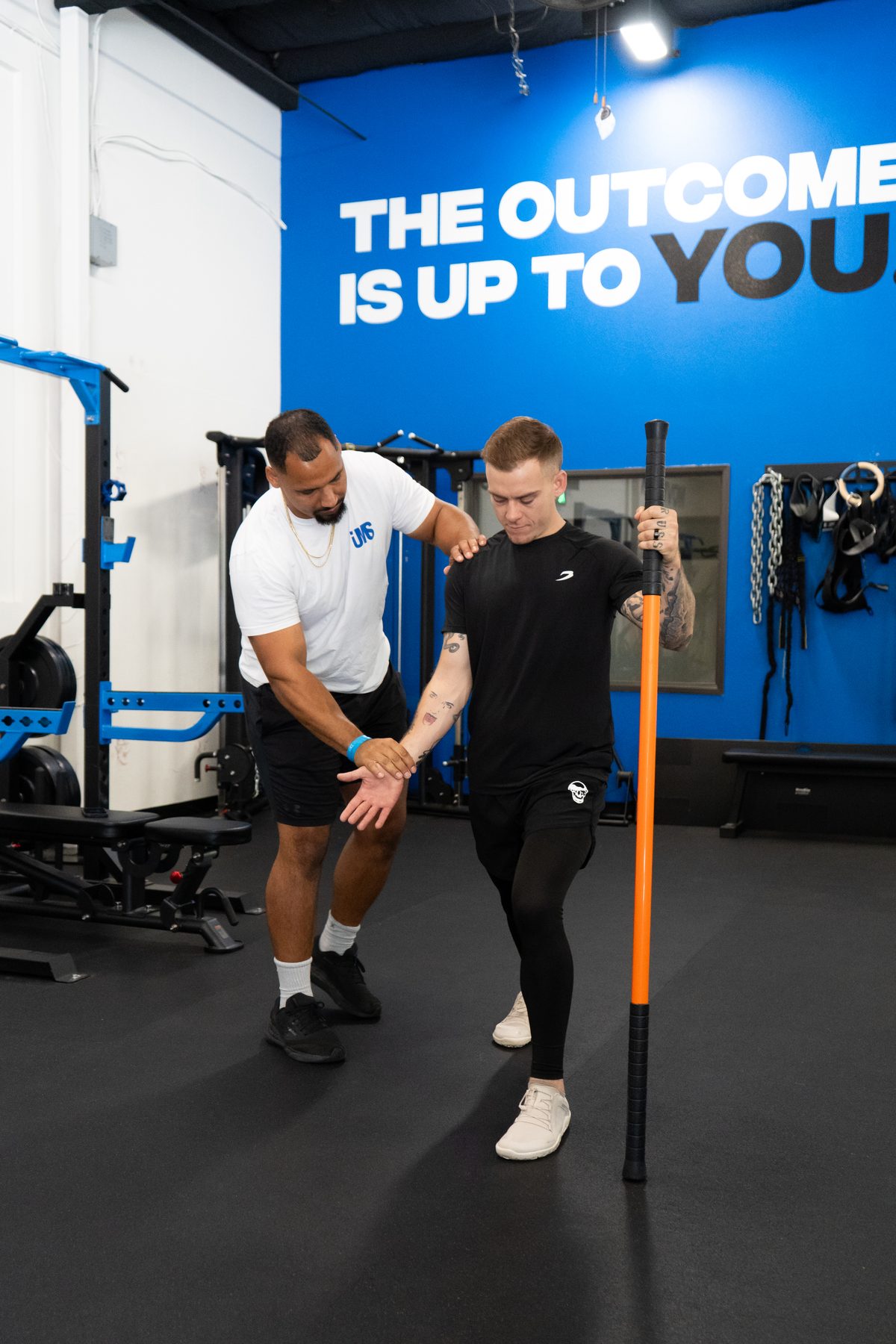
Here is a pattern I see constantly, and lived through myself.
Someone gets hurt. They see a physical therapist, who is good, and who gets them out of pain over eight weeks. Discharge comes with a sheet of exercises. The person then returns to the gym — to a trainer, or to their own program — and within a few months they're back where they started.
Nobody in that chain did anything wrong. The failure is in the gaps between them.
What the gaps look like
The PT's job ended at pain resolution and basic function. That's the scope. What it doesn't include is progressive loading back to the thing you actually want to do, over the following year.
The trainer, meanwhile, never saw the assessment. They know there "was a shoulder thing." They don't know which ranges were restricted, what compensations showed up, or which positions to load carefully. So they program around the injury by avoiding it — which feels responsible and quietly guarantees the area never gets strong.
And nobody is watching the thing over months. Discharge notes don't get revisited. The exercise sheet goes in a drawer. The person self-assesses using the only tool they have, which is whether it currently hurts.
Why "does it hurt" is a bad instrument
Pain is a late signal and a noisy one. Plenty of restricted, poorly controlled joints don't hurt at rest. They hurt when something unusual happens — a weekend of yard work, a pickup game, a heavy box at an awkward angle.
So "it doesn't hurt anymore" tells you the tissue calmed down. It doesn't tell you whether you've regained the range you lost, whether you can control that range under load, or whether the compensation you developed during the painful months is still running.
That last one matters more than people expect. Compensations are efficient. Your body finds a way to accomplish the task around the restricted joint, and then keeps using it long after the restriction resolves, because it works. The load just gets distributed somewhere it wasn't designed to go — which is often where the next problem shows up, in a different place, a year later.
What measuring instead looks like
The alternative to "does it hurt" is a number you own.
A joint-by-joint assessment records what each joint can actively produce and control — not what it can be pushed into. That becomes your baseline. Six weeks later you re-check the same joints, and the comparison is against your own previous numbers rather than an age chart or a population average.
This is unglamorous and it's the difference between a program and a series of workouts. It also makes progress legible in a period where nothing feels dramatically different, which is most of the useful periods.
Load is the goal, not the enemy
The instinct with an old injury is to protect it forever. Avoid the range. Skip the movement. Work around it.
But avoidance is why the area stays weak, and weak is why it keeps flaring. The sequence that works is: establish what range you actively control, expand that range deliberately, then load it — progressively, in the positions you now own.
The order matters enormously. Loading a range you don't control is how people get hurt again. Never loading anything is how people stay fragile. The assessment is what tells you which one you're doing.
What I'd want you to take from this
If you're carrying something from years ago and you've concluded it's just how your body is now, I'd push back on that — not with a promise, but with a question. When was the last time anyone actually measured it?
Not asked whether it hurts. Measured it, joint by joint, and wrote the numbers down.
Most people have never had that done. It's the entire content of a Movement Assessment, it takes thirty minutes, and there's no cost to finding out.
IMS provides coaching, movement education, and recovery services. IMS does not diagnose, treat, or cure medical conditions. If you have pain, a recent injury, or surgical history, consult a licensed healthcare provider — and if that's where you should start, I'll tell you so.