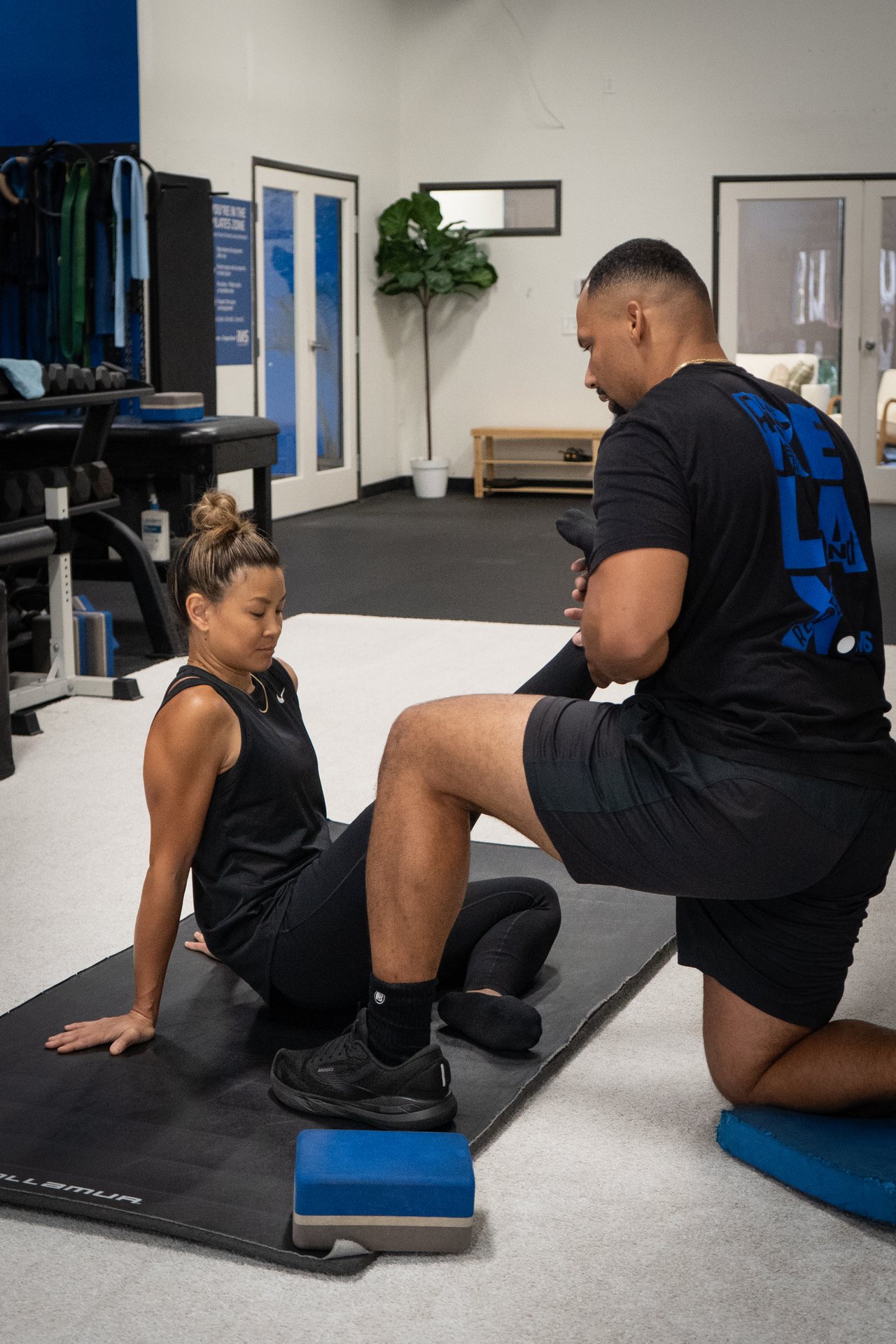
People book the free assessment and then message me the night before asking what to wear, whether they need to be fit already, and whether it's really free. Fair questions. Nobody likes walking into an unfamiliar room without knowing the shape of the next half hour.
So here it is, start to finish.
Before you arrive
Wear whatever you can bend and reach in. You will not be training, so gym clothes are optional — but jeans and a stiff button-down will get in the way of me seeing what your hips and shoulders are doing.
Eat normally. Park directly outside Suite D. Bring nothing.
The first ten minutes: we talk
I want three things from this part.
What you want to be able to do. Not "get in shape" — the specific thing. Carry a kayak. Play a full round without your back seizing on the back nine. Get off the floor without using your hands. Keep up on a hike with your kids. The specific answer changes the program; the vague one doesn't.
What your body has been through. Surgeries, injuries, the shoulder that's been "a bit off" since 2019, anything a doctor has told you. I need the history because it changes what I load and what I leave alone.
What your week actually looks like. A program that needs four sessions from someone who can commit to two is a program that fails in month two.
The next fifteen: the screen
This is the part that makes IMS different from a gym tour, and it's the part people find unexpectedly interesting, because most have never had it done.
I take you through your joints one at a time — neck, shoulders, spine, hips, knees, ankles — and I look at what each one can produce on its own. Slowly. No load, nothing strenuous, nothing that should hurt.
What I'm measuring is active range: what you can get into and control yourself. Not what I could push you into. That distinction is the whole point. Range that only appears when someone else supplies the force isn't range you own, and it isn't range you can use when your foot lands wrong on a trail.
Three things show up in this screen, every time, in almost everybody:
- Asymmetry. One hip rotates further than the other. One shoulder gets overhead cleanly and the other takes a detour through the ribcage. Bodies are never perfectly even, but a clear gap is worth understanding.
- Compensation. You reach overhead and your low back arches to help. You rotate and your knees swing along. Your body is solving the task — just not with the joint that's supposed to be solving it.
- The stutter. A joint moves smoothly and then hits a spot where it shakes, catches, or jumps ahead. That's the edge of what your nervous system controls.
None of these are diagnoses. They're observations about how you moved on a Tuesday morning, written down.
The last five: what it means
I tell you what I saw, in plain language, without jargon and without a sales pitch attached.
Usually that sounds like: "your ankles are the reason your squat looks the way it does, and if we chase the squat without touching the ankles you'll be back here in six months." Or: "your shoulders are actually fine — what's happening is a thoracic spine that hasn't rotated in a decade."
Then one of three things happens.
Coaching makes sense. I'll explain what a program would address and what it would look like. You decide, then or later. Nobody signs anything on the day.
Coaching doesn't make sense yet. If what I'm seeing looks like something a licensed healthcare provider should evaluate first — pain that behaves a certain way, a history that needs clearing — I'll tell you that instead, and I'll mean it. IMS doesn't diagnose or treat anything. Selling training to someone who needs a physician is how people get hurt.
You're fine. Some people come in, screen clean, and leave with a couple of things to work on themselves. That's a good outcome. It's also why the assessment is free — charging for it would make me want a different answer.
What you leave with
A clear read on how your joints are moving right now, and a baseline. If you do train here, we re-check the same joints every six to eight weeks and compare against your own numbers rather than a chart. If you don't, you still know more about your body than you did thirty minutes earlier.
The common questions, answered
Do I need to be fit? No. There's no fitness prerequisite and no training involved.
Is it really free? Yes. No card, no deposit, no obligation.
Will it hurt? It shouldn't. Everything is slow, unloaded, and within your own control. If something is painful, we stop and that becomes useful information.
How old are your clients? Twenties into the seventies. The screen is the same; what it finds is different.
If you want the short version first, the movement self-check is six of these tests you can do at home in four minutes. It's not the same as having someone watch you — but it'll tell you whether this is worth thirty minutes of your time.
IMS provides coaching, movement education, and recovery services. IMS does not diagnose, treat, or cure medical conditions. If you have pain, a recent injury, or surgical history, consult a licensed healthcare provider.